
Understanding the Role of Intelligent Agents in AI
Estimated reading time: 12 minutes
Key Takeaways
-
- Intelligent agents are autonomous entities capable of perceiving their environment and acting to achieve specific goals.
-
- They are foundational to artificial intelligence and are driving innovation in various industries.
-
- Intelligent agents possess attributes such as autonomy, reactivity, proactivity, and social ability.
-
- Different types include simple reflex agents, model-based agents, goal-based agents, utility-based agents, and learning agents.
-
- Real-world examples include virtual personal assistants, autonomous vehicles, chatbots, recommendation systems, and gaming agents.
- Intelligent agents play a significant role in advancing AI technologies but also pose challenges and ethical considerations.
Table of Contents
Introduction
An intelligent agent in AI refers to an autonomous entity capable of perceiving its environment through sensors and acting within that environment using actuators to accomplish specific goals. These agents work independently, make their own decisions, and adapt to changing circumstances, making them foundational to the operation and advancement of artificial intelligence. Intelligent Agent Definition.
As technological advancements continue to unfold, intelligent agents in AI have emerged as cornerstones of modern artificial intelligence, driving innovation in diverse industries and applications. Their capabilities are revolutionizing how we interact with technology, leading to solutions for complex issues and enhancing efficiency. Multi Agent Systems: A Comprehensive Guide to Scaling AI Agents for Business.
In this blog post, we aim to provide readers with a clear understanding of intelligent agents, explain how they function, and present real-world examples showcasing their impact in artificial intelligence.
What is an Intelligent Agent?
Definition of an Intelligent Agent
An intelligent agent is fundamentally characterized as an autonomous entity that perceives its environment through sensors and acts upon this environment using actuators to achieve particular goals. The core attributes of these agents include:
-
- Autonomy: Independent operation without requiring immediate human intervention.
-
- Reactivity: The ability to respond to changes in the environment promptly.
-
- Proactivity: Initiative-taking to accomplish predefined objectives.
- Social Ability: Capability to interact with other agents or humans effectively.
For more insights, you can dive into the Intelligent Agent Definition.
Differentiation Between General Agents and AI Intelligent Agents
Intelligent agents in artificial intelligence distinguish themselves from general software agents through their exceptional abilities to learn, reason, and make complex decisions based on the environment they perceive. These differences become crucial when we consider their real-time decision-making capabilities versus traditional algorithms which may merely follow preset rules. Intelligent Agent in Artificial Intelligence Examples.
Intelligent Agents in Artificial Intelligence
Overview of Artificial Intelligence and Its Relationship with Intelligent Agents
Artificial intelligence (AI) seeks to create systems that can perform tasks that typically require human intelligence, such as understanding natural language, recognizing patterns, and making decisions. Within this realm, intelligent agents serve as the fundamental building blocks, acting as autonomous units that execute AI functionalities. Their understanding of their environment and ability to make informed decisions empower AI systems to function more autonomously and intelligently. OpenAI Deep Research: Revolutionary AI Tool Transforms Professional Research Capabilities.
How Intelligent Agents Fit Within the Broader AI Landscape
Intelligent agents integrate seamlessly into various AI applications, including:
-
- Machine Learning: For training algorithms that learn from data.
-
- Natural Language Processing: To understand and generate human language.
- Robotics: For creating responsive and adaptive machines.
These integrations have played a pivotal role in developing adaptive AI systems that can learn and respond to dynamic environments efficiently.
The Role of Intelligent Agents in Advancing AI Technologies
The essential contributions of intelligent agents toward AI advancement can be summarized as follows:
-
- Automation: Enabling efficient, automated systems that reduce human effort.
-
- Personalization: Tailoring interactions and services according to individual preferences.
- Intelligent Decision-Making: Assisting humans in making smarter, data-driven decisions.
How Intelligent Agents Work
Core Components of an Intelligent Agent
The functioning of an intelligent agent involves several core components:
-
- Perception: The agent gathers information from the environment through sensors, for instance, a camera in a self-driving car that detects road signs.
-
- Reasoning: It processes and analyzes the collected data to induce actionable insights.
-
- Learning: Enabled to improve performance based on past experiences and adapt to new information. OpenAI Deep Research: Revolutionary AI Tool Transforms Professional Research Capabilities.
- Action: The agent executes decisions through actuators to influence the environment.
The Decision-Making Process in AI Intelligent Agents
An AI intelligent agent typically undergoes a structured decision-making process comprised of:
-
- Perceiving the state of the environment.
-
- Evaluating possible actions based on goals and expected outcomes.
-
- Selecting the most suitable action using logical reasoning and utility calculations.
-
- Executing the chosen action promptly.
- Observing results and updating knowledge for refined future decisions.
Technical Mechanisms Enabling Intelligent Behavior
The autonomous behavior of intelligent agents is facilitated by various technical mechanisms, including:
-
- Algorithms: Defined procedures that dictate actions based on input data.
-
- Machine Learning Models: Allow agents to improve and adapt over time. OpenAI Deep Research: Revolutionary AI Tool Transforms Professional Research Capabilities.
-
- Neural Networks: Computational models inspired by human brain processing.
- Feedback Loops: Mechanisms for continuous learning and adaptation.
Types of AI Intelligent Agents
Simple Reflex Agents
Simple reflex agents are built to act solely based on the current percept and ignore the history of percepts. These agents utilize condition-action rules to determine actions effectively. For example, an automatic door opener reacts to the presence of a person nearby. Intelligent Agents
Model-Based Agents
Model-based agents maintain an internal state that reflects aspects of the world not visible through current percepts. By using this state as a reference, they operate effectively in partially observable environments, adjusting their actions according to historical context.
Goal-Based Agents
Goal-based agents act with the objective of achieving specific goals, evaluating their current state and possible future states to drive their actions towards desired outcomes. These agents analyze various pathways and choose those leading closest to their goals.
Utility-Based Agents
Utility-based agents decide based on a utility function that quantifies the agent’s level of satisfaction or happiness with different states. This approach directs them to choose actions that maximize overall utility, a crucial attribute in complex decision-making scenarios.
Learning Agents
Learning agents improve their performance through experiences by utilizing elements such as a learning module that adapts their behavior over time. Key components include a performance element, critic to judge performance, and a problem generator for identifying new challenges. OpenAI Deep Research: Revolutionary AI Tool Transforms Professional Research Capabilities.
Comparison and Use Cases for Each Type
-
- Simple Reflex Agents: Typical use case includes automatic doors responding to movement.
-
- Model-Based Agents: Used in robotic systems navigating through dynamic environments.
-
- Goal-Based Agents: Found in GPS systems that find optimal routes based on changing traffic conditions.
-
- Utility-Based Agents: Applied in investment bots tasked with maximizing financial returns.
- Learning Agents: Employed in recommendation systems for platforms like Netflix or Amazon that enhance user interaction.
Examples of Intelligent Agents in Artificial Intelligence
Virtual Personal Assistants
Virtual personal assistants like Siri, Alexa, and Google Assistant utilize natural language processing and machine learning to facilitate interactions with users. They exemplify intelligent agents that perform tasks based on spoken commands, learning from interactions to better serve user needs. Intelligent Agents.
Autonomous Vehicles
Self-driving cars represent some of the most complex uses of intelligent agents, integrating various sensors and AI technologies to navigate roads and ensure safety. These vehicles process real-time data to make informed driving decisions, demonstrating advanced intelligent behavior. Intelligent Agent in Artificial Intelligence Examples.
Chatbots and Customer Service Agents
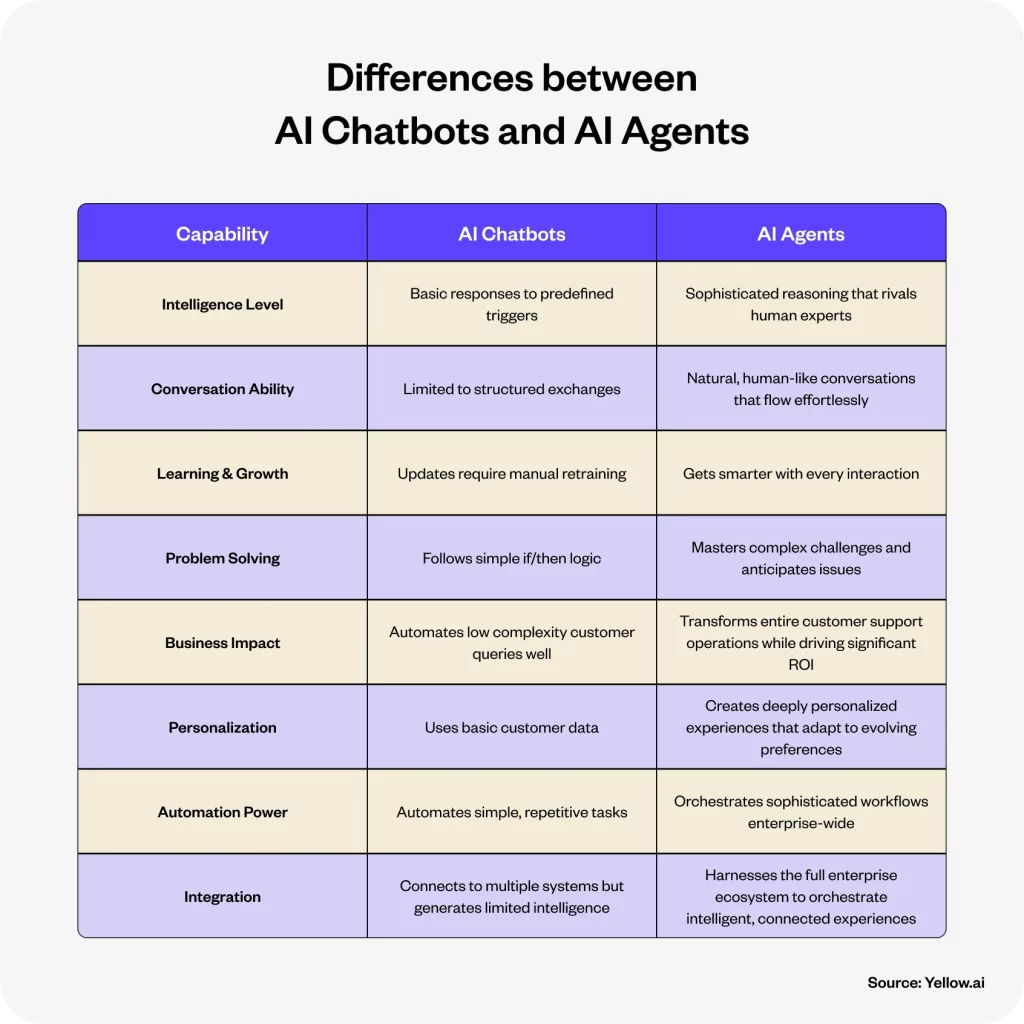
AI-powered chatbots streamline customer interactions by managing inquiries, providing support, and enhancing service efficiency. These intelligent agents analyze customer queries and respond accordingly, improving organizational customer service outcomes. Intelligent Agent Examples.
Recommendation Systems
Platforms like Netflix and Amazon employ intelligent agents that analyze user behavior to personalize suggestions effectively. These systems track preferences and past interactions, enhancing user experience through tailored recommendations. AI Agent Overview.
Gaming Agents
In video games, non-player characters (NPCs) leverage intelligent agents to simulate realistic and adaptive behaviors, enriching the gaming experience. These agents respond dynamically to player actions, contributing to immersive gameplay. Intelligent Agent – Wikipedia.
AI Agents Explained
Detailed Breakdown of AI Agents’ Functionalities
The operations of AI agents involve a continuous cycle of perception, reasoning, action, and learning. This cycle allows them to process inputs from their environment, generate appropriate outputs, and refine their operations over time in response to user feedback and environmental changes.
How AI Agents Interact with Their Environment
Example: Smart Thermostat
-
- Perceives the temperature and occupancy in a room via sensors.
-
- Reasons about the optimal temperature settings considering user preferences and energy efficiency.
-
- Acts by regulating heating or cooling systems based on real-time data.
- Learns from user behavior and historical trends to enhance future performance. Intelligent Agent Definition.
Examples Illustrating AI Agents in Action
Real-life scenarios such as fraud detection systems in banking, predictive maintenance in industrial equipment, and personalized shopping experiences illustrate the diverse applications of intelligent agents across numerous sectors.
Artificial Intelligence and Intelligent Agents
The Synergy Between AI Advancements and Intelligent Agent Capabilities
Advancements in AI technologies efficiently enhance intelligent agents’ functionalities. Improved algorithms, increased computing capabilities, and refined machine learning models are enabling agents to operate more effectively and intelligently. OpenAI Deep Research: Revolutionary AI Tool Transforms Professional Research Capabilities.
Impact of Intelligent Agents on Various Industries
The influence of intelligent agents is profound, touching several industry sectors:
-
- Healthcare: Intelligent agents assist in diagnosing conditions and monitoring patients, enhancing healthcare delivery.
-
- Finance: Automated trading systems powered by intelligent agents streamline financial transactions and customer service.
-
- Manufacturing: Robotics employing intelligent agents optimize production processes and operational efficiencies.
- Transportation: Intelligent agents facilitate traffic management and logistics optimization, increasing efficiency and safety.
Future Trends in AI Intelligent Agents
Several trends shaping the future of AI intelligent agents include:
-
- Enhanced Emotional Intelligence: Developing agents capable of recognizing and responding to human emotions.
-
- Improved Multi-Agent Collaboration: Enabling agents to work together seamlessly to tackle complex problems. Multi Agent Systems: A Comprehensive Guide to Scaling AI Agents for Business.
-
- Integration with IoT Devices: Facilitating smooth interactions between intelligent agents and connected systems.
- Advanced Reasoning with Quantum Computing: Leveraging quantum technologies for sophisticated problem-solving capabilities.
Benefits and Challenges of Intelligent Agents
Benefits
-
- Increased Efficiency and Productivity: Automating routine tasks results in significant time and cost reductions.
-
- 24/7 Availability and Scalability: Intelligent agents operate continuously without fatigue, accommodating varying workloads.
-
- Personalized User Experiences: Tailored services enhance customer satisfaction and engagement.
- Capacity for Handling Complex Tasks and Large Datasets: Intelligent agents rapidly process and analyze vast data, offering timely insights.
Challenges
-
- Ensuring Ethical Decision-Making: The need to address biases and ensure fairness in agent-driven decisions.
-
- Maintaining Data Privacy and Security: Protecting sensitive information from cyber threats and unauthorized use.
-
- Overcoming Limitations in Contextual Understanding: Continuous improvements are required to enhance agents’ understanding of nuanced contexts.
- Managing the Potential Impact on Human Jobs: Understanding workforce implications and fostering human-agent collaboration is essential.
Ethical Considerations in Deploying Intelligent Agents
Deploying intelligent agents necessitates addressing ethical considerations, including the need for transparent and explainable AI decisions, establishing accountability for agent actions, and implementing measures to mitigate biases effectively.
Conclusion
Recap of Key Points About Intelligent Agents in AI
In summary, intelligent agents are autonomous entities in AI, characterized by their decision-making abilities, adaptability, and independent operation. Their functionalities and types span a broad spectrum from simple reflex agents to advanced learning agents. The impact of intelligent agents in AI is evident in various real-world applications, demonstrating their growing presence.
The Significance of Intelligent Agents in the Future of AI
As intelligent agents progress, their significance in further advancing AI technologies becomes increasingly vital. They hold the potential to reshape industries by solving complex problems and enhancing interaction within everyday life.
Encouragement for Further Exploration and Learning
I invite readers to remain engaged with developments in intelligent agents, explore educational resources, and consider careers within the flourishing realm of artificial intelligence.
Additional Resources
Suggestions for Related Topics or Advanced Studies
-
- Delving deeper into machine learning algorithms that underpin intelligent agents.
-
- Exploring multi-agent systems and their collaborative strategies.
- Studying ethical AI development practices for responsible AI deployment.
By understanding and exploring the role of intelligent agents in AI, readers can appreciate their substantial impact on technology and society, leading to an informed perspective on these dynamic innovations.
Frequently Asked Questions
What is an intelligent agent in AI?
An intelligent agent in AI is an autonomous entity that perceives its environment through sensors and acts upon that environment using actuators to achieve specific goals.
How do intelligent agents work?
Intelligent agents work by continuously perceiving their environment, processing inputs to make decisions, and executing actions. They can learn from experiences and adapt their behavior over time.
What are examples of intelligent agents?
Examples of intelligent agents include virtual personal assistants like Siri and Alexa, autonomous vehicles, AI-powered chatbots, recommendation systems on platforms like Netflix and Amazon, and gaming NPCs.
What are the benefits of using intelligent agents?
Benefits include increased efficiency and productivity, 24/7 availability, personalized user experiences, and the capacity to handle complex tasks and large datasets.
What are the challenges associated with intelligent agents?
Challenges include ensuring ethical decision-making, maintaining data privacy and security, overcoming limitations in contextual understanding, and managing the potential impact on human jobs.